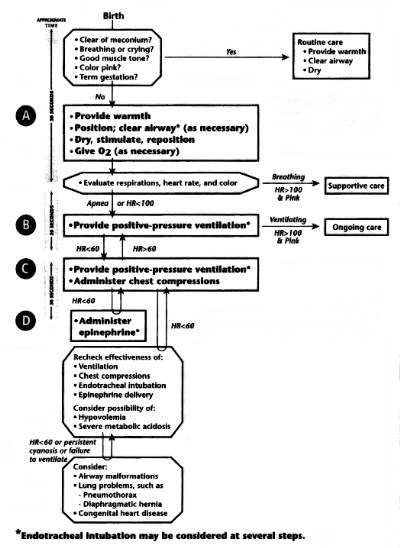
The most important and effective action in neonatal resuscitation is ventilation
of the baby's lungs with oxygen.
A - Airway
B - Breathing
C - Circulation
D - Drugs
| Gestational Age (weeks) |
Weight (kg) |
ET tube size (ID, mm) |
Depth of insertion* (cm from upper lip) |
| < 28 |
< 1.0 |
2.5 |
6 - 7 |
| 28 - 34 |
1.0 - 2.0 |
3.0 |
7 - 8 |
| 34 - 38 |
2.0 - 3.0 |
3.5 |
8 - 9 |
| > 38 |
> 3.0 |
3.5 - 4.0 |
9 - 10 |
| Medication |
Concentration |
Preparation |
Dosage/Route |
Rate/Precautions |
| Epinephrine |
1:10,000 |
1:10,000
solution in 1mL syringe |
0.1-0.3mL/kg
ET/IV |
Give
rapidly, flush with 0.5-1mL NS |
| Volume
Expanders |
NS,
Ringer's, O- blood |
Large
syringe |
10mL/kg
IV (umbilical vein) |
Give
over 5-10mins |
| Sodium
Bicarbonate |
4.2%
solution |
Prefilled/prepared
syringe |
4mL/kg
IV (umbilical vein) |
Give
slowly (0.5mL/kg/min) ONLY if effective ventilation |
| Naloxone
(for narcotic-induced respiratory depression)
|
0.1mg/kg
IV/ET/IM/SQ |
Give
rapidly |
||
| Glucose
(for hypoglycemia)
|
D10W |
2mL/kg
IV |
Give
over 1-2mins, then continuous infusion |
|
| Phenobarbital
(for seizures)
|
20mg/kg
IV |
Give
slowly (1mg/kg/min), may depress respiratory effort |
||
| Dopamine
(for hypotension)
|
2-20mcg/kg/min
IV |
Continuous
infusion |